What’s been driving EU ETS carbon prices in 2026?
“If you take one thing from this section, it’s that the volatility is, for the most part, the market repricing political risk. So far this year, EU carbon has traded a lot more on policy narratives and geopolitics than on fundamentals,” said Henry Lush as he introduced the webinar’s first topic about EU ETS price action.
EUAs opened the year around EUR 86/t and pushed towards EUR 90/t in mid-January, the high for the year so far. Geopolitical tension over Greenland kept a lid on prices into February, before the market hit its first real inflection point between 10 and 13 February, as a run of ETS-specific headlines took over: rumours of Commission plans on pre-allocation, reports that rapporteur Peter Liese was floating a 3.4–3.5% linear reduction factor (LRF), and, most significantly, German Chancellor Merz calling for the ETS to be revised or postponed. The Merz comments were later walked back, but not before driving the highest trading volumes of the year — around 90 million tonnes — and a price drop from roughly EUR 80/t to below EUR 70/t within days.
Prices kept falling as the war in Iran added geopolitical risk on top of continued EU policy pressure, with industry and policymakers both pushing for bearish changes to the system. The market bottomed at a new low of EUR 62/t in mid-March. Veyt’s call at the time was that the sell-off was overheated: no proposal was expected until later in the year, and when it came, it would target the post-2030 period rather than deliver the short-term fix some were demanding. That call turned out to be right.
The turning point came at a late-March EU summit, where Commission President Ursula von der Leyen responded to the pressure from member states and industry by committing to more firepower for the Market Stability Reserve (MSR) and to publishing an ETS review by July. The market then went quiet and range-bound, and, being structurally tight drifted upward through the spring, growing progressively numb to escalations in the Iran war.
By July, prices had sold off sharply again, to around EUR 78/t, on headlines that the Commission’s framework would be more bearish than expected. When the proposal was actually published on 17 July, prices spiked to around EUR 86/t within days before correcting as the market worked through the detail.
How has the EU ETS revision shaped up, and what are the key elements?
The Commission’s revision of the EU Emissions Trading System is now in front of the Council and the Parliament. Veyt’s analysts summarized the review as: “Overall, the review is a step down in ambition and a step up in flexibility.”
The proposal cuts the LRF from its current 4.4% to 3.7% in 2031 and 1.7% in 2036 — equivalent to annual cap reductions of around 77 million and 35 million tonnes respectively. That 1.7% figure is only workable alongside new flexibilities: international credits purchased through a joint facility from 2036 (reverting to a 2.7% LRF if that credit supply fails to materialise), and a one-off top-up of 260 million allowances spread across 2031–2040 to reflect the contribution of CRCF-certified permanent removals, both inside and outside ETS-covered installations. The net effect, according to Veyt analysis, is that the cap now reaches zero ten years later than under current legislation, with the cumulative carbon budget growing by 1.6 gigatonnes.
Two new mechanisms position the EU ETS as an investment engine rather than just a cap-and-trade system. The Industrial Decarbonisation Bank will pay out 400 million EUAs from 2028–2031 to industrial decarbonisation projects, first-come first-served, with allowances released only once a project is approved and, later, based on emissions actually avoided. However, there’s no guarantee of when these allowances are actually going to reach the market, given the planning, application and approval processes involved.
A second IDB phase will auction a further 400 million allowances, carved out of the cap, to fund carbon contracts for difference. The Innovation Fund continues with 200 million allowances for earlier-stage projects, and 50% of member-state auction revenue will now be targeted at ETS-covered sectors rather than broader environmental spending.
On carbon leakage, a separate near-term benchmark file will top up allocation for installations on fallback benchmarks between 2026 and 2030, timed to arrive with the 2027 allocation.
The main proposal adds conditionality to pre-allocation: to get their full allocation, installations must show a plan to reinvest it in domestic decarbonisation, with a clawback if production is later moved abroad. Free-allocation flexibility rises from 3% to 4%, and new benchmark reduction rates mean benchmarks won’t tighten much further than they already have.
The EU ETS revision also brings new sectors under its scope. Waste (including incineration and hazardous waste) will be covered from 2031, scaling up to 36 million tonnes by 2034. Extra-EU aviation will be brought in from 2029, for flights within 5,000km of Frankfurt — covering Turkey, parts of the Middle East, the Balkans and North Africa, but explicitly excluding long-haul routes such as China or the US.

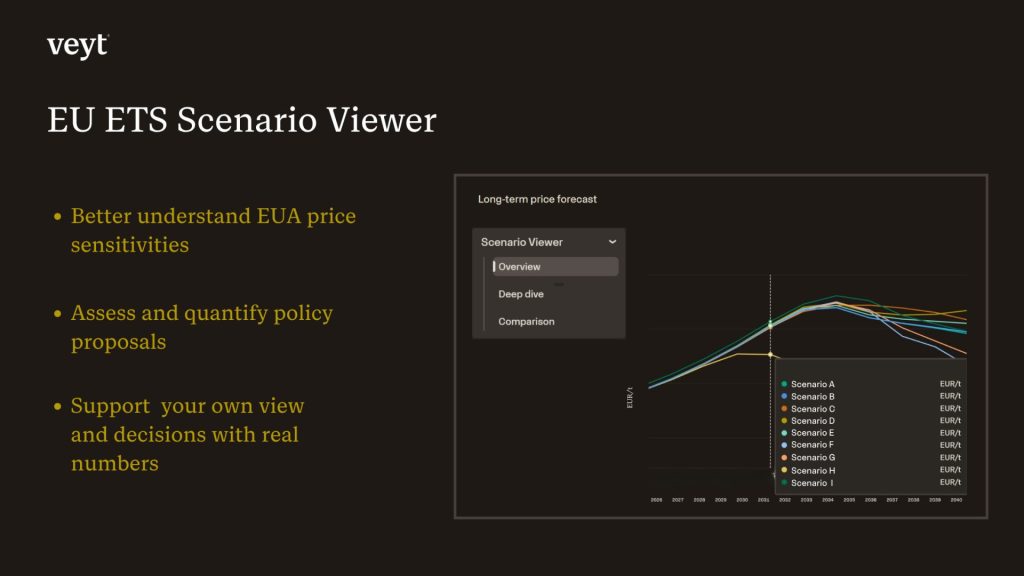
Looking to understand the price impact of various design options? Learn about Veyt Scenario modelling
The political landscape for the EU ETS revision
The EU ETS revision needs sign-off from both the Council, representing the 27 member states governments, and the European Parliament before it can become law, — and neither has settled on a position yet. “I would say right where we are now, it is still a very long way to consensus among the 27 countries,” said Anders Nordeng.
On the Council side, he described a widening bloc around Poland and Hungary, joined by Italy, Greece and Estonia, opposed to the reform’s direction, with conditionality a particular sticking point. On the other side, the Nordics, Spain, Portugal, Luxembourg and the Netherlands are pushing to protect ETS ambition and integrity. Germany and France sit closer to the middle; Germany was reportedly close to signing a joint letter with seven ETS-champion countries before pulling out, though both governments appear broadly supportive of the proposal.
The Parliament is further behind. It received the proposal on the same date as the Council but went into summer recess, and while MEP Peter Liese had said, as of the webinar, that he aimed to publish his report that same week, procedural details are still being confirmed. The far right holds large blocs of seats but has struggled to build a working alliance, leaving Liese’s usual coalition of Renew, the S&D and, to some extent, the Greens intact. The EPP group itself is split, Anders Nordeng noted, between members still committed to the climate consensus reached in 2019 and those now keen to unwind parts of it.
What is the timeline for deciding the new EU ETS rules and what could each milestone mean for the market? Contact us about access to Veyt’s running calendar of the revision’s milestones, and analysis around the select dates and events that matter most.
How does Veyt cover the EU ETS revision, and how can you get ongoing analysis of the EU ETS Review?
Veyt has analysed carbon markets since their inception. Our analysts are invited regularly to speak at industry events and participate in roundtable discussions in Brussels.
Coverage runs from a daily market report and weekly market and policy assessments through to a running position tracker and roadmap for the revision’s progress through the Council and Parliament, plus in-depth analyst notes. All of it feeds Veyt’s short- and long-term price forecasts and market balances, built from scenarios based on the team’s own inputs and analysis.
This analysis is available through the Veyt platform, APIs, or through consulting engagements built around a specific business need.
Learn more