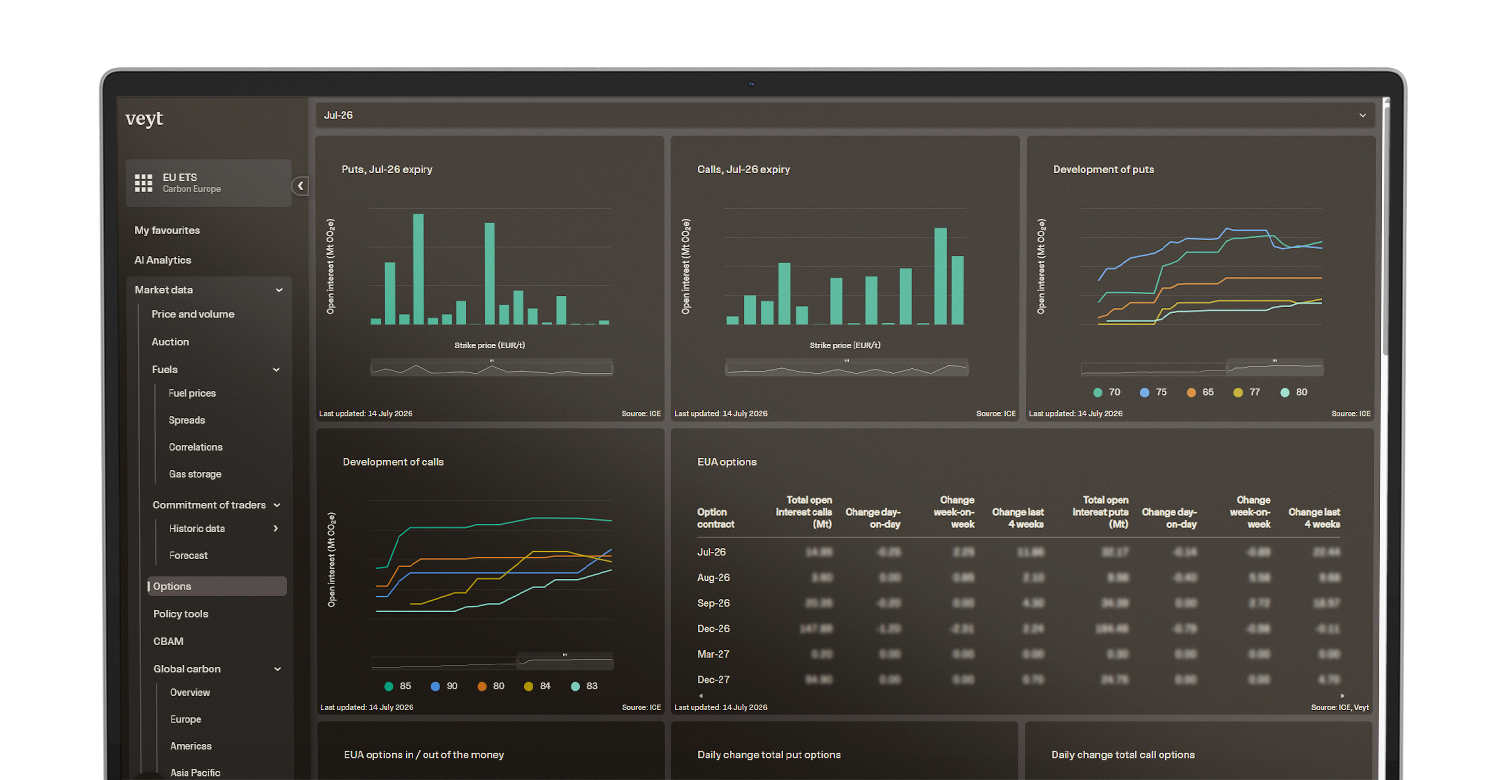
Carbon market intelligence for valuation and pricing teams

Set defensible carbon price assumptions, test valuation sensitivity, and quantify policy-driven price risk across global carbon markets.

Veyt combines carbon market data, proprietary models, and analyst interpretation to help valuation and pricing teams move from isolated price inputs to traceable assumptions grounded in market balance, policy pathways, and emissions fundamentals.

  • EU ETS
  • EU ETS2
  • North American Carbon
  • Global Carbon Credits

Intelligence platform

Data API

Modern market intelligence platform with API and Excel integration

Newsletter

Industry

Net zero market solutions

What valuation and pricing teams monitor with Veyt

Carbon price assumptions need to hold up across investment committees, valuation models, transaction processes, and internal risk reviews. Veyt helps teams connect market pricing, modelled forecasts, policy scenarios, and underlying fundamentals into a consistent valuation view.

Valuation inputs and assumptions teams need

These are the inputs valuation and pricing teams use to build carbon price assumptions that are transparent, consistent, and testable.
Carbon price forecasts
  • Short-, medium-, and long-term forecasts support valuation assumptions across horizons
  • Forecast ranges help reflect uncertainty rather than a single fixed price view
  • Modelled price trajectories provide a basis for internal pricing assumptions
Market pricing and historical data
  • Historical prices provide context for current and future assumptions
  • Observable market pricing supports near-term benchmarking
  • Differences between market prices and modelled forecasts highlight assumption risk
Policy scenarios
  • Policy scenarios show how regulatory design choices affect price outcomes
  • Alternative market design assumptions create different valuation ranges
  • Scenario outputs support sensitivity analysis across investment cases
Market balance outlook
  • Supply–demand balance helps explain long-term price direction
  • Structural surplus or tightness affects future carbon price assumptions
  • Balance shifts provide context for changes in forecast trajectories
Emissions, allocation, and auction data
  • Emissions data supports exposure and compliance cost assumptions
  • Allocation and auction data affect expected supply and market balance
  • Underlying datasets make valuation assumptions easier to trace and review
Drivers
Tracking short- and long-term market trends to clarify current and potential impacts from disparate drivers
Market behaviour
Analysing participant behaviour and market sentiment while commenting on price drivers. An in-depth focus on industry sectors by understanding their marginal abatement costs and trade behaviour allows for informed decision-making. Our pan-European power market modelling is the backbone for our granular utility-sector insights and hedging strategy analysis
Policy developments
Following relevant European carbon and energy market legislation, providing foresight on political outcomes, and assessing market impacts
Supply & demand forecasts
Generating insights on how policy ambition and regulatory change shape short- and long-term supply dynamics. Addressing sensitivities of key assumptions for EU ETS market participants. Following sector-specific trends, production data, and decarbonisation pathways to track and forecast demand for carbon European Union allowances (EUAs)
Technical analysis
Identifying key trends in the market, spotting relevant support/resistance levels, and technical patterns
Market data
Key market data for the EU ETS and the wider energy complex. Prices, volume, open interest, seasonality charts to assess liquidity, and participant behaviour
Market prices do not answer long-term valuation questions
Policy outcomes can materially change valuation
Market balance is modelled, not directly observable
Carbon exposure differs by asset, sector, and region
Internal assumptions often lack consistency

Why carbon price assumptions are difficult to defend

Carbon price assumptions are often challenged because they depend on future policy design, market balance, emissions behaviour, and energy market assumptions. A single price input rarely explains enough.

Key carbon market drivers valuation teams monitor

Valuation and pricing teams monitor the drivers that shape long-term carbon price assumptions, not only short-term price movements.
Regulatory design defines market structure and future compliance obligations
Policy reform can shift long-term supply, demand, and price expectations
Scenario analysis helps translate policy uncertainty into valuation ranges
Allocation, auctions, emissions, and compliance demand determine market tightness
Structural balance affects long-term carbon cost assumptions
Market balance changes explain shifts in forecast trajectories
Power and fuel prices influence emissions and allowance demand
Fuel switching affects marginal carbon demand and abatement incentives
Energy market assumptions feed into carbon price modelling
Industrial output affects emissions and compliance demand
Economic cycles influence energy consumption and carbon market balance
Sector-level activity shapes future carbon exposure across assets
Abatement costs influence long-term carbon price trajectories
Technology deployment affects structural allowance demand
Sector decarbonisation pathways change future compliance exposure
Market positioning can affect current pricing and benchmark assumptions
Liquidity conditions influence observed prices and near-term valuation inputs
Divergence between market pricing and fundamentals highlights assumption risk

How valuation and pricing teams use Veyt

Veyt helps valuation teams move from static carbon price inputs to structured assumptions that can be tested, compared, and explained.

Price assumption setting
Valuation sensitivity analysis
Benchmarking and validation
Policy scenario testing
Cross-market valuation support
Price input
  • Current market price
  • Historical price data
  • Forecast trajectory
  • Scenario price path
  • Internal model assumption
Assumption review
  • What policy pathway does it reflect?
  • What market balance does it assume?
  • Which emissions and allocation inputs support it?
  • How does it compare with market pricing?
  • How sensitive is the valuation to this input?
Valuation output
  • Defensible carbon price assumption
  • Scenario-based valuation range
  • Carbon cost sensitivity view
  • Policy-adjusted valuation case
  • Consistent pricing input across models

Carbon valuation workflow

From price input to defensible assumption

Veyt supports the workflow from selecting a carbon price input to testing and defending the assumptions behind it.

Customisable views for valuation and pricing workflows

Different valuation teams need different levels of detail depending on asset exposure, investment horizon, and internal governance requirements.
Valuation and financial modelling teams
Investment and strategy teams
Risk and scenario teams
Corporate finance and transaction teams
Quantitative and modelling teams

Carbon valuation platform — at a glance

The Veyt platform gives valuation and pricing teams access to carbon forecasts, market balance models, policy scenarios, structured datasets, and analyst commentary.
Carbon price forecasts
Compliance market balance
Policy scenario analysis
Historical price and activity data
Emissions and allocation datasets
Cross-market carbon insights

What the platform provides

Standard capabilities

Additional capabilities

Who this is for

Additional users

Join our newsletter

Newsletter Subscribe

Veyt is committed to protecting and respecting your privacy, and we’ll only use your personal information to administer your account and to provide the products and services you requested from us. From time to time, we would like to contact you about our products and services, as well as other content that may be of interest to you. You may unsubscribe from these communications at any time. Click here to view our terms and conditions.

Consent

Innovation

Innovation for us is a mindset encompassing the courage to challenge norms and the adaptability to evolving landscapes. Our commitment means we go beyond technological advancements, aspiring to redefine what’s possible.

Search