EAC market intelligence for risk management and hedging

Assess certificate cost exposure, market balance risk, and regulatory uncertainty across Energy Attribute Certificate (EAC) markets.

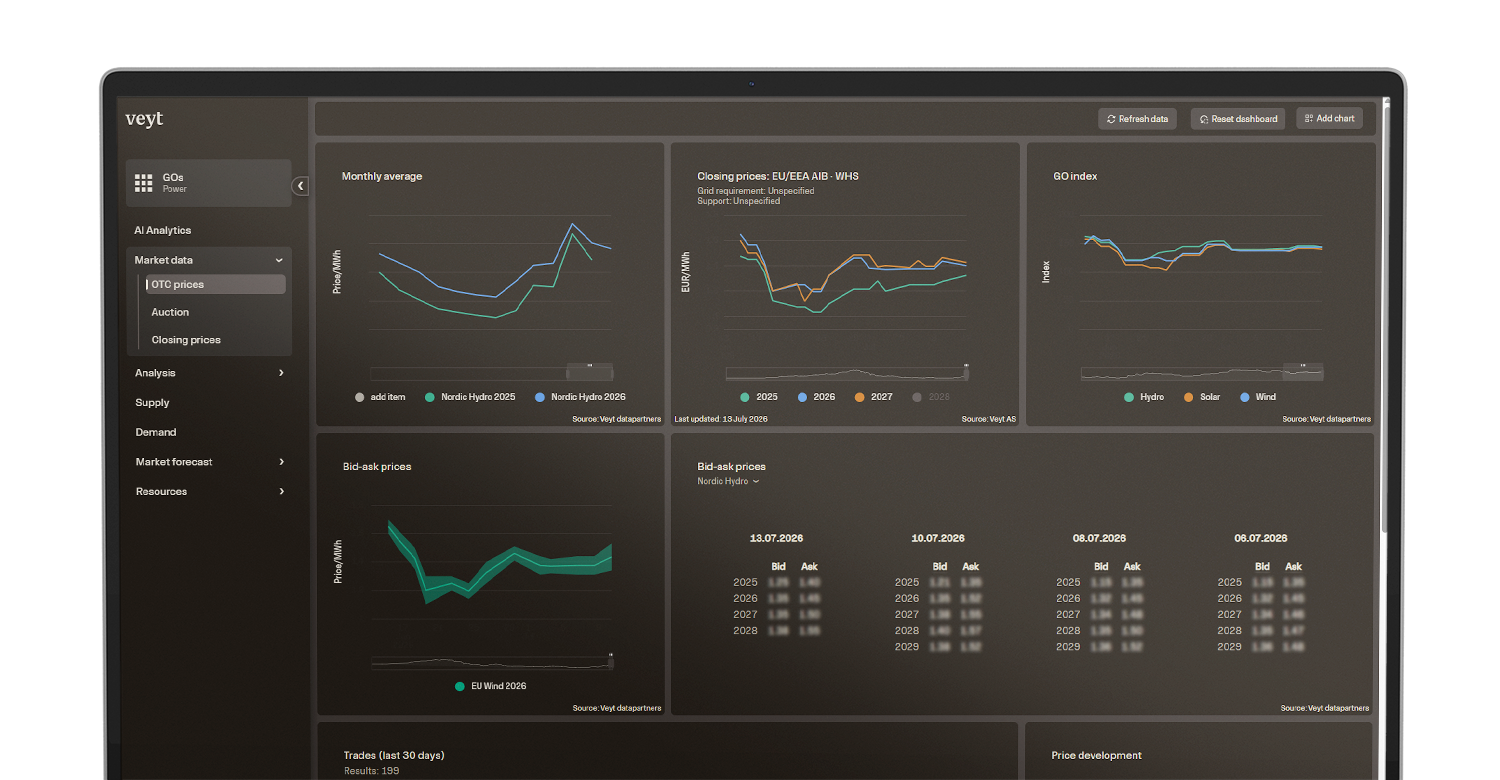
Veyt helps risk and hedging teams monitor pricing, liquidity, issuance, cancellations, and forecast developments across European GOs, UK REGOs, and international EAC markets.

  • European GOs
  • UK REGOs
  • International EAC markets

Intelligence platform

Data API

Modern market intelligence platform with API and Excel integration

Newsletter

Industry

Net zero market solutions

Decision signals risk and hedging teams monitor

Risk and hedging teams need visibility into the market signals that affect certificate cost exposure, sourcing risk, and future procurement conditions.

Certificate price exposure

  • Track certificate prices across technologies, vintages, and geographies
  • Compare GO, REGO, and international EAC pricing developments
  • Monitor pricing shifts affecting procurement costs and exposure assumptions

Bid-ask spreads and liquidity

  • Monitor bid-ask spreads across key certificate products
  • Assess liquidity conditions across compliance periods and vintages
  • Identify where thin liquidity may affect execution and price confidence

Auction and transaction activity

  • Track auction prices and volumes by technology
  • Monitor recent transactions by price, volume, vintage, technology, and geography
  • Use market activity to benchmark exposure and hedge assumptions

Issuance and cancellations

  • Monitor certificate issuance and cancellation trends
  • Assess whether market balance is tightening or loosening
  • Track changes in certificate availability across markets

Forecast developments

  • Compare short-, medium-, and long-term market outlooks
  • Track forecast revisions across technologies, vintages, and countries
  • Monitor spreads between production years and certificate categories

Policy and disclosure signals

  • Monitor disclosure rules and cancellation requirements
  • Track policy developments affecting certificate demand
  • Assess how market rules influence sourcing risk and demand timing

Why EAC exposure is challenging to manage

EAC exposure is not defined by price alone. Risk teams need to connect market pricing, certificate availability, disclosure frameworks, and future market balance before setting exposure assumptions or hedging strategies.

Why EAC policy advocacy requires market intelligence

Policy design affects more than compliance language. It can change certificate eligibility, cancellation behaviour, sourcing strategies, liquidity, and long-term market balance.
Policy changes affect demand timing
  • Disclosure deadlines influence when certificates are cancelled
  • Reporting requirements affect procurement and sourcing behaviour
Certificate rules affect market access
  • Eligibility requirements determine which certificates can be used
  • Recognition rules affect cross-border sourcing and market participation
Market design influences liquidity
  • Market rules can change available supply and trading activity
  • Liquidity conditions affect how policy changes are absorbed
Supply-demand impacts are not always immediate
  • Policy changes can affect market balance over several compliance periods
  • Long-term impacts depend on generation, cancellations, and demand growth
Country rules differ across certificate systems
  • National frameworks affect disclosure, cancellation, and recognition
  • Advocacy positions require comparable market evidence across jurisdictions
Drivers
Tracking short- and long-term market trends to clarify current and potential impacts from disparate drivers
Market behaviour
Analysing participant behaviour and market sentiment while commenting on price drivers. An in-depth focus on industry sectors by understanding their marginal abatement costs and trade behaviour allows for informed decision-making. Our pan-European power market modelling is the backbone for our granular utility-sector insights and hedging strategy analysis
Policy developments
Following relevant European carbon and energy market legislation, providing foresight on political outcomes, and assessing market impacts
Supply & demand forecasts
Generating insights on how policy ambition and regulatory change shape short- and long-term supply dynamics. Addressing sensitivities of key assumptions for EU ETS market participants. Following sector-specific trends, production data, and decarbonisation pathways to track and forecast demand for carbon European Union allowances (EUAs)
Technical analysis
Identifying key trends in the market, spotting relevant support/resistance levels, and technical patterns
Market data
Key market data for the EU ETS and the wider energy complex. Prices, volume, open interest, seasonality charts to assess liquidity, and participant behaviour

Key EAC market drivers risk teams monitor

EAC market risk is shaped by certificate supply, cancellation demand, liquidity, policy frameworks, and long-term renewable electricity demand.

Renewable generation determines certificate issuance volumes
Technology mix affects availability across certificate categories
Weather conditions influence generation and short-term supply
Cancellation activity shows realised certificate demand
Supplier obligations influence demand across compliance periods
Corporate procurement affects voluntary market demand
Issuance and cancellations determine market tightness
Liquidity affects price transparency and execution confidence
Imports and exports influence regional certificate availability
Auction prices and volumes indicate market sentiment
Trade activity shows where market interest is concentrated
Bid-ask spreads reveal liquidity and pricing confidence
Disclosure rules influence cancellation deadlines and demand timing
Market rules affect certificate eligibility and sourcing behaviour
Policy developments shape future market expectations
Electrification may increase renewable electricity demand
Renewable hydrogen production may affect future certificate demand
Decarbonisation pathways shape long-term market balance

How risk and hedging teams use Veyt

Veyt brings EAC pricing, liquidity, market balance, forecasts, and policy analysis into one workflow for managing certificate exposure.

Exposure assessment
Hedging strategy support
Scenario and forecast review
Policy and compliance risk monitoring
Market balance monitoring

Customisable views for different risk workflows

Risk and hedging teams focus on different signals depending on exposure, compliance period, geography, and certificate type.
Risk management teams
Hedging teams
Procurement risk teams
Utilities and suppliers
Quantitative and modelling teams

EAC intelligence platform — At a glance

The Veyt EAC intelligence platform combines market data, forecasts, and analyst interpretation into a single analytical workflow.

Market balance forecasts
Issuance and cancellation outlooks
Long-term market outlooks
Country market analysis
Interactive pricing visuals
Policy and disclosure frameworks
Multi-term market forecasts
Analyst market commentary

What the platform provides

Standard capabilities

Additional capabilities

Who this is for

Additional users

Join our newsletter

Newsletter Subscribe

Veyt is committed to protecting and respecting your privacy, and we’ll only use your personal information to administer your account and to provide the products and services you requested from us. From time to time, we would like to contact you about our products and services, as well as other content that may be of interest to you. You may unsubscribe from these communications at any time. Click here to view our terms and conditions.

Consent

Innovation

Innovation for us is a mindset encompassing the courage to challenge norms and the adaptability to evolving landscapes. Our commitment means we go beyond technological advancements, aspiring to redefine what’s possible.

Search