
The EU Emissions Trading System 2 (EU ETS2) is a new cap-and-trade system designed to reduce greenhouse gas (GHG) emissions from road transport, buildings, and small-scale industries not covered by ETS1. The system is similar in structure to the existing EU ETS (ETS1). It expands carbon pricing to sectors that have so far been slower to decarbonise and will play a central role in meeting the European Union’s climate targets for 2030, 2040, and 2050.
Under EU ETS2, the emissions cap is set to reduce emissions by 42 per cent by 2030 compared to 2005 levels, as outlined in the European Commission’s presentation.
Policymakers set an emissions cap that declines over time, and regulated entities must surrender emission allowances corresponding to the emissions embedded in the fuels they place on the market. Allowances under ETS2 are known as EUA2s. Fuel providers compete for a limited number of allowances but are not assigned individual emission caps. Instead, the overall cap is enforced through the market.
Regulated entities must:
Monitor the emissions inherent in the fuels they sell
Engage an independent third-party verifier
Report emissions to their national ETS2 authority
Surrender the corresponding number of allowances
EU ETS2 is expected to cover around 1,000 Mt of CO₂ in 2027, roughly comparable in scale to ETS1. In that year, close to 1,300 million EUA2s are expected to be auctioned, consisting of an initial cap of 1,036 million allowances and approximately 250 million allowances frontloaded from later years to support early liquidity.
While EU ETS2 complements ETS1, the two systems differ in several important ways.
Allocation: ETS2 starts with 100 per cent auctioning of allowances. ETS1 still includes elements of free allocation to industry.
Decision-making: In ETS2, fuel providers account for emissions, but end-users determine fuel consumption. Fuel providers can pass on costs and have limited ability to influence demand.
Market maturity: ETS1 is a mature market with deep liquidity, historical price data, and active secondary trading. ETS2 will begin without these features.
Price dynamics: There is no structural reason to expect prices in ETS1 and ETS2 to be correlated.
EU ETS2 places a carbon price on emissions from sectors that have historically reduced emissions more slowly than power generation and heavy industry.
Without meaningful abatement in road transport and buildings, the European Union will not meet its climate targets. ETS2 is intended to close this gap, reduce dependence on imported fossil fuels, and incentivise investment in clean technologies across Europe.
EU ETS2 targets upstream fuel providers that sell oil, gas, or coal for use in:
Road transport
Heating and cooling of buildings
Fuels used in agriculture, forestry, and leisure boating are excluded by default, although some member states have chosen to include these emissions in their national implementation.
National ETS2 authorities are responsible for identifying regulated entities. For oil and gas, this typically includes suppliers already registered in tax warehouses. However, authorities often need more granular procedures to distinguish between covered and non-covered fuel uses.
Coal distributors present additional challenges, as coal products are not uniformly subject to excise duties across Europe.
Preliminary estimates suggest that approximately 11,400 fuel providers across Europe registered monitoring, reporting, and verification (MRV) plans and reported 2024 emissions by the deadline of 30 September 2025.
EUA2s will be issued through auctions starting in January 2027. These allowances can be used to account for emissions from 2028 onwards.
While no physical market exists yet, futures trading has already begun. In May 2025, ICE launched the first EU ETS2 futures contracts, followed by EEX in July. Both platforms offer contracts for delivery in 2027 and 2028, when physical trading is expected to be underway.
This allows fuel providers to begin hedging their carbon exposure, although liquidity remains limited. Once auctions commence, futures trading is expected to grow rapidly and may become the dominant trading segment, as seen in ETS1. Increased participation by financial investors is likely to further enhance liquidity.
Watch the EU ETS 2 Outlook Webinar with EEX and Veyt
EU ETS2 is designed to reflect supply and demand for allowances and to provide a price signal that encourages emissions reductions.
To address concerns about excessive price volatility, the system includes a Market Stability Reserve (MSR). The MSR can release additional allowances if:
The total number of allowances in circulation falls below a defined threshold
Prices reach €45 per tonne (indexed for inflation) or remain persistently above recent averages
In October 2025, the European Commission proposed further enhancements to the MSR, including higher outflow limits, a shift from absolute to dynamic price triggers, and the carry-over of unused allowances beyond 2030.
Unlike some national systems, EU ETS2 does not include a fixed allowance price or a formal price corridor. This contrasts with the German national emissions trading system for road transport and buildings (nETS, Nationales Emissionshandelssystem), which has operated with fixed prices and a price corridor.
For price drivers, supply-demand analysis, market balance, and forecasts, see Veyt EU ETS 2 Intelligence.
The Social Climate Fund (SCF) was created to mitigate the social and economic impacts of ETS2, particularly for vulnerable households and small businesses.
The fund will mobilise approximately €86 billion between 2026 and 2032, primarily from auctioning ETS2 allowances, supplemented by member state contributions. Funding may be used to support energy efficiency improvements, insulation, heat pumps, and electric vehicle adoption.
To access funding, member states must transpose ETS2 into national law and submit social climate plans to the European Commission. While transposition was initially due by mid-2024, some countries have yet to complete this process.
The creation of a separate emission trading system for road transport and buildings was one of the key achievements of the ETS Directive revision in 2022 (formally adopted in May 2023), as this will greatly expand the scope of carbon pricing.
Europe’s fuel providers had until 15 September 2024 to submit an emissions monitoring plan to the relevant national authorities, to be approved by 1 January 2025. They needed to report 2024 emissions by 30 April 2025.
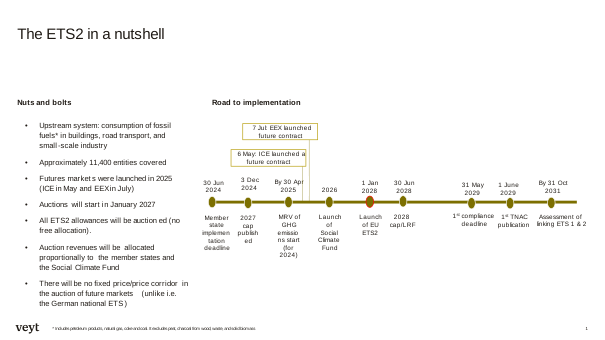
On 3 December 2024, the European Commission published the 2027 emission cap, fixed at 1,036 Mt CO2. See more on the Veyt Portal, here.
In May 2025, ICE, a trading platform, launched the first ETS2 futures contract (see more on the Veyt Portal, here), for delivery in December 2028. EEX, another platform, followed suit in July.
The European Commission was originally intended, to assess by 15 July 2026, whether oil and gas prices will be high enough to warrant a one-year delay in the ETS2 launch (January 2028 instead of January 2027). This clause is no longer relevant after the recent decision by member states to simply postpone the start to 2028 (the Environment Council on 5 November).
As for ETS2 auctions, there was a push for early auctions to start in 2026 (when the expectation was still for compliance obligations from 2027). Following the decision to delay compliance to 2028, the European Commission proposed on 8 December 2025 to start early auctioning in January 2027. Member states that have properly implemented ETS2 can start offering their volumes from that date onwards.
January 2027 will also be the start of the sale of 450 m EUA2s for the Social Climate Fund. The SCF is launched already in 2026, allowing member states to start disbursing funding to households limit the impact of ETS2-incurred increases in their energy bills. The first batch of funding, €50 billion, was raised in 2025, from auctioning EUAs (the allowance units used in ETS1). From January 2027 onwards, the lion’s share of the funding will come from auctioning ETS2 allowances.
After ETS2 becomes fully operational – with compliance obligations – in 2028, the first deadline for surrendering allowances will be 31 May 2029, to account for GHG let out in 2028.
The diagram below provides a high-level visualisation of the EU ETS 2 implementation timeline.
No. By default, national authorities are required to include all fuel providers supplying fuels used for road transport, heating and cooling of buildings, and on-site combustion in small-scale industries not covered by EU ETS1. Member states may request permission from the European Commission to expand or exempt certain types of fuel combustion.
Several countries have already opted to broaden their EU ETS2 scope. Austria, Finland, the Netherlands, and Sweden have chosen to include additional segments such as leisure boats and machinery or vehicles used in forestry and agriculture (see more here). The rationale for this approach is partly to capture a larger share of emissions and partly to simplify the analysis and reporting of fuel volumes subject to EU ETS2.
Conversely, member states may apply for general exemptions from EU ETS2 if fuel providers are already subject to a tax equivalent to or higher than the cost of EUA2 allowances.
In addition, countries may theoretically expand the scope of EU ETS1 by lowering the minimum entry threshold. This would allow some small-scale industries to fall under ETS1 rather than ETS2.
Germany represents a special case. It is the only member state with a national fuel emissions trading system for heating and buildings in place since 2021, covering almost the same sectoral scope as EU ETS2. This national system is scheduled to be integrated into EU ETS2 by 2027. Until then, Germany’s national pricing regime continues with a fixed price of EUR 55 per tonne in 2025, to be replaced by a price corridor between EUR 55 and EUR 65 per tonne in 2026.
When a member state expands or restricts the ETS2 scope, the supply of EUA2 allowances is adjusted accordingly.
Despite the delayed start of EU ETS2, European upstream fuel providers – the entities targeted by ETS2 – will still need to proceed with the same preparations. They need to monitor inherent emissions, have their emission reports validated by independent consultants, and submit them by 30 April every year.
As for the surrender of allowances, the delay implies that the first deadline is now set to be on 31 May 2029, for 2028 emissions.
The delay does imply that the cost increase – which will ultimately be shouldered by households – will hit one year later. Yet, for fuel providers there is no reason to lower their guard. They still need to follow closely the upcoming regulatory changes, and many of them will still want to hedge their exposure upfront.
For that, given the low liquidity in the ETS2 futures market, much hope is pinned on the ETS2 auctions that should start in January 2027.
Most of the rules on the ETS 2 are set out in the revised ETS Directive, in a new Chapter IVa (articles 30a-k). Some of the rules pertaining to the ETS market stability reserve (MSR) are given in the revised Auctioning Regulation, Article 1a.
Compliance entities and other market participants benefit from the following:
Want to track market developments and know what is happening? Veyt offers monthly analyst updates, policy updates, detailed market analysis and price forecasts through our online portal. Register for free monthly updates.
See also: Veyt cuts long-term outlook for EU ETS 2 prices 17% to EUR 180. Montel News – English
Veyt uses proprietary fundamental models to analyse the supply and demand dynamics in the EU ETS2, and provide allowance price forecasts.
If you would like access to our data, forecasts or have general questions about the market, Send your questions to our dedicated team of EU ETS2 specialists by emailing contact@veyt.com.
Early EU ETS2 prices are likely to be sensitive to trading activity, MSR interventions, and compliance readiness. As the market matures and obligations take effect, upward price pressure is expected.
Veyt provides monthly analyst updates, policy insights, detailed market analysis, and price forecasts through its online portal. Free monthly updates are available for those wishing to follow market developments closely.


