The power market dynamics in recent years, including rising imbalance costs and cannibalisation of renewable capture prices, have prompted many European IPPs and project developers to fundamentally rethink their approach – moving away from single-asset evaluation towards a portfolio-level perspective.
This was also the case for Hydro Rein, who was actively exploring portfolio diversification to reduce operational risks related to the volatility and uncertain delivery profiles of single assets.
The client wanted to understand:

“Faced with a time-critical need for robust portfolio analysis, Veyt could deliver quickly because they already had the data sets and the intellectual horsepower we thought was required. Also, they clearly understood the topics due to their solid trading backgrounds.
They delivered complex modelling in a very short timeframe and continuously engaged with us to explain the results
and underlying drivers, giving us the confidence and clarity to advance internal strategic decisions.”
Robert Gorosch | Head of Commercial and Business Development BU Europe | Hydro Rein
Veyt leveraged its in-house models and extensive datasets spanning from high-resolution weather data to long-term power market forecasts.
Portfolio optimisation
Veyt used a synthetic generation series of all wind projects in the region to identify low-correlated assets and optimise the portfolio configuration. To achieve this on a short time scale, Veyt could rely on high-quality datasets readily available in-house for plug-and-play modelling, including high resolution weather data combined with a proprietary database of European wind and solar assets.
Forecast error and imbalance modelling
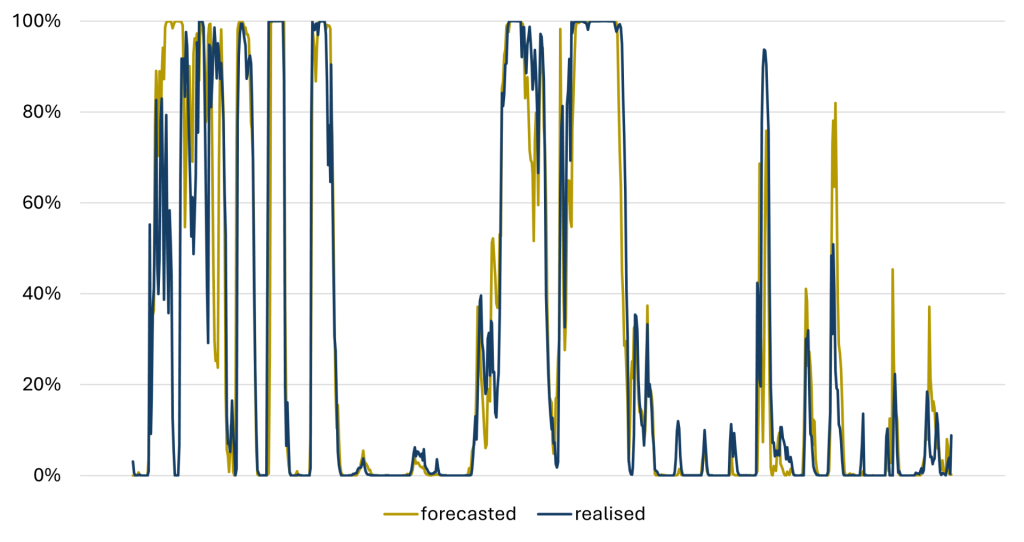
Forecast errors were computed by comparing simulated forecasted and realised generation on both the asset and portfolio level. This step relied on historical weather forecast data that Veyt continuously collects in a gridded dataset across Europe, ready to use for modelling synthetic generation profiles at different forecast stages. Using imbalance prices and considering repositioning in the intra-day market, Veyt could quantify how much the portfolio reduced overall imbalance costs.
Long-term firming and cannibalisation analysis
Veyt applied a future power market forecast across ten weather years to value generation, calculate cannibalisation and assess long-term firming costs towards baseload delivery for different scenarios. This analysis was conducted using the Veyt Base Case, an in-house fundamental long-term scenario of the European power market.
Simulated forecasted versus realised generation

Above: Imbalance cost reductions were calculated using simulated forecasted versus realised generation based on high-resolution historical weather forecast data
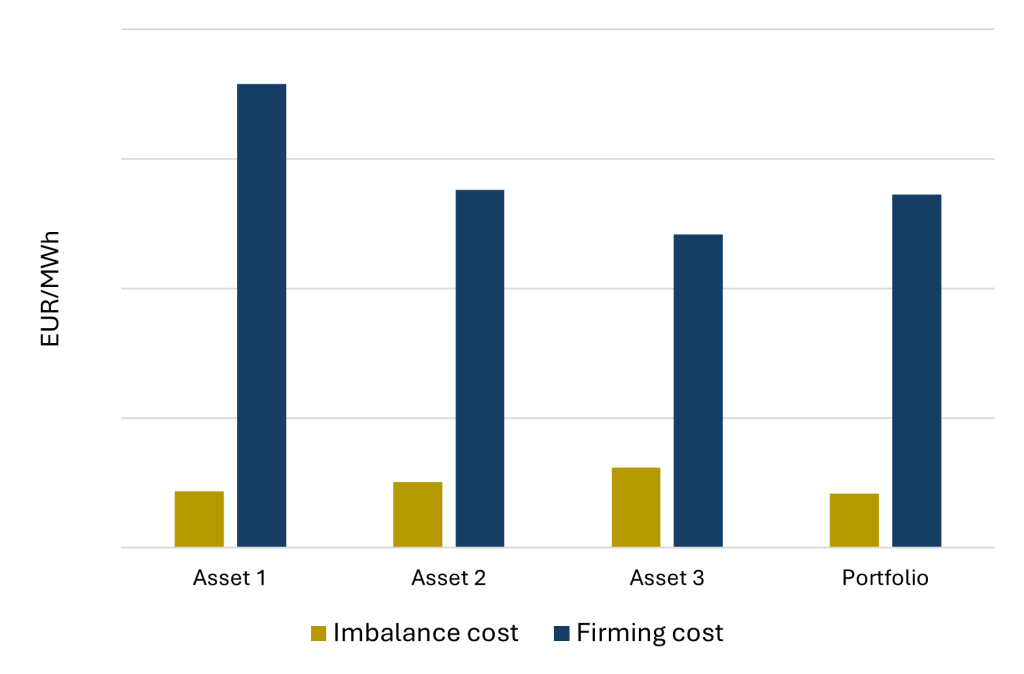
The analysis confirmed the hypothesis that an optimised portfolio provides a positive impact on imbalance costs, firming costs, and associated risk.
Overall, the results showed strong evidence of portfolio synergies while surfacing optimisation potential.
Standalone assets versus portfolio: imbalance and firming cost

Above: Exemplary imbalance cost and firming cost comparison for standalone assets and portfolio

“The use of historical weather data unlocked key insights on forecast accuracy and imbalance costs relevant to us and our balancing responsible party (BRP). Combined with Veyt’s long-term power market forecast the analysis painted a clear picture of imbalance cost and firming risk reductions.”
Robert Gorosch | Head of Commercial and Business Development BU Europe | Hydro Rein
Whether evaluating portfolio expansion, acquisition opportunities, or operational risk exposure, Veyt combines market intelligence, proprietary modelling, and actionable analysis to support more informed renewable energy investment decisions.
To discuss portfolio strategy or market expansion plans, contact us.