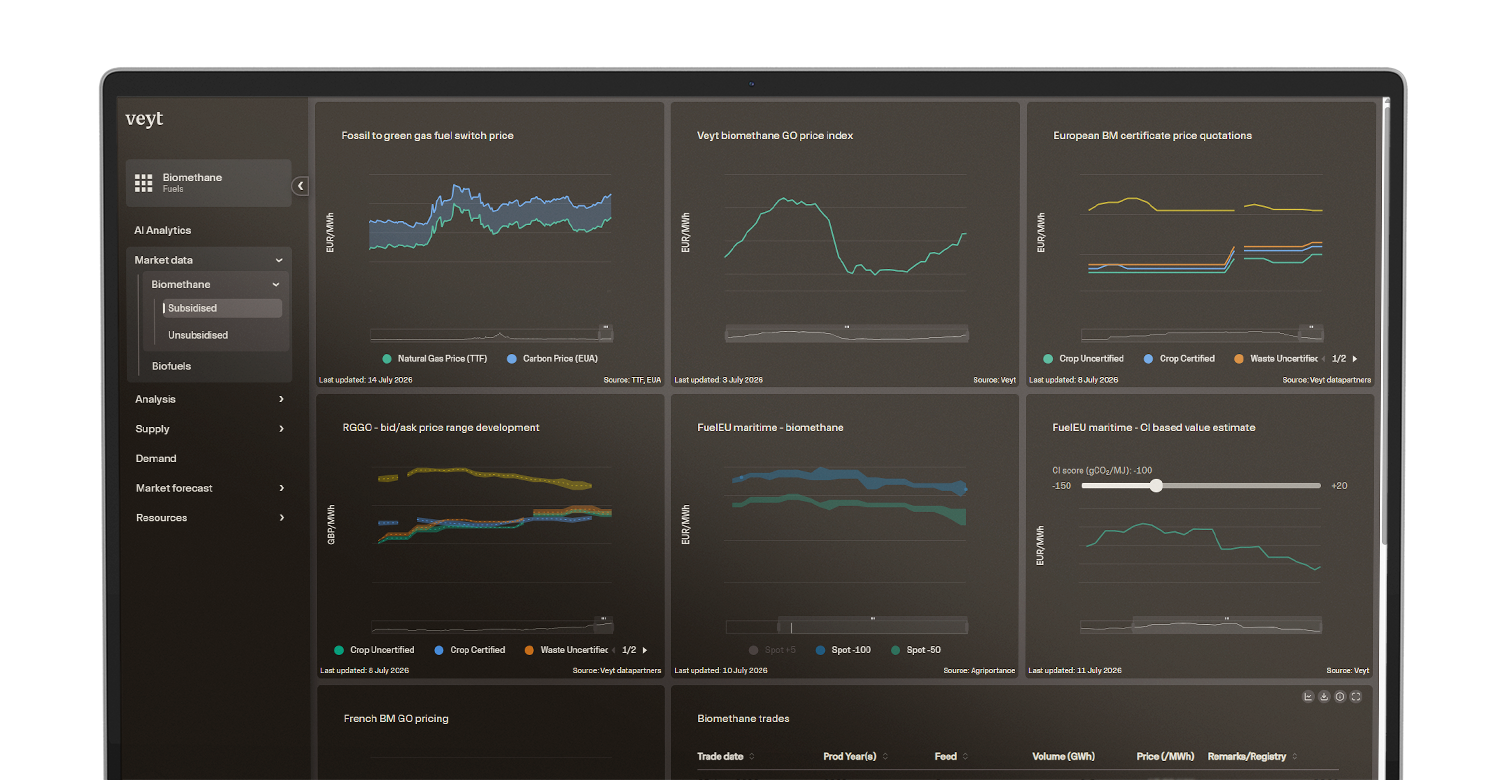
Fuels market intelligence for valuation and pricing

Build fuel price assumptions, assess certificate value, and compare regulatory cost impacts across biomethane and maritime fuel markets.

Veyt helps valuation and pricing teams connect fuel prices, certificate markets, production costs, transport costs, EU ETS costs, FuelEU impacts, and long-term demand assumptions.

  • Biomethane
  • Biofuels
  • Bio-LNG
  • Maritime fuels
  • FuelEU Maritime
  • EU ETS maritime

Intelligence platform

Data API

Modern market intelligence platform with API and Excel integration

Newsletter

Industry

Net zero market solutions

Pricing inputs valuation teams rely on

Valuation and pricing teams need traceable inputs that explain how fuel value changes across markets, regulation, and end-use sectors.

Why fuels price assumptions are difficult to defend

Fuel pricing depends on physical supply, certificate value, emissions costs, compliance credits, and infrastructure readiness. Valuation teams need to connect each price component to its underlying driver.

Fuel value has several components
  • Biomethane value includes physical fuel and certificate components
  • Maritime fuel cost includes bunker, emissions, and compliance impacts
  • Production and transport costs affect long-term fuel economics
Certificate pricing is market-specific
  • Gas GO and biomethane certificate systems differ across countries
  • Eligibility and sustainability requirements affect certificate value
  • Registry development influences market transparency and tradability
Regulatory costs change relative value
  • EU ETS maritime increases cost exposure for fossil fuels
  • FuelEU Maritime changes the value of low-emission fuel options
  • National quota systems affect certificate demand and pricing
Long-term fuel pricing depends on adoption
  • Fleet and orderbook data shape future maritime demand assumptions
  • Infrastructure readiness affects achievable fuel uptake
  • Demand growth can change value before supply fully scales
Market data needs policy context
  • Trades and auctions show pricing but not full market logic
  • Compliance frameworks explain why fuel values diverge
  • Pricing assumptions need to reflect regulation and end-use demand

Key fuels market drivers valuation teams monitor

Fuel valuation is shaped by production costs, certificate markets, regulatory costs, infrastructure constraints, and demand development.
Production costs influence long-term renewable fuel value
Transport costs affect delivered fuel economics
Conventional fuel prices shape fuel-switching thresholds
Certificate prices reflect policy-driven demand and eligibility
Green premiums indicate value above fossil fuel alternatives
Sustainability certification affects market access and pricing
EU ETS costs affect fossil fuel competitiveness in shipping
FuelEU costs and credits change relative fuel value
National quota systems influence low-carbon fuel demand
Production capacity affects physical fuel availability
Infrastructure readiness constrains fuel adoption and delivered value
Project status changes confidence in future supply assumptions
Maritime demand depends on vessel adoption and orderbooks
Road transport demand depends on filling station networks
Aviation demand depends on SAF mandates and supply availability
RED certification affects renewable fuel eligibility
Gas GO registry development affects certificate liquidity
Country-specific rules influence end-use value and tradability
Drivers
Tracking short- and long-term market trends to clarify current and potential impacts from disparate drivers
Market behaviour
Analysing participant behaviour and market sentiment while commenting on price drivers. An in-depth focus on industry sectors by understanding their marginal abatement costs and trade behaviour allows for informed decision-making. Our pan-European power market modelling is the backbone for our granular utility-sector insights and hedging strategy analysis
Policy developments
Following relevant European carbon and energy market legislation, providing foresight on political outcomes, and assessing market impacts
Supply & demand forecasts
Generating insights on how policy ambition and regulatory change shape short- and long-term supply dynamics. Addressing sensitivities of key assumptions for EU ETS market participants. Following sector-specific trends, production data, and decarbonisation pathways to track and forecast demand for carbon European Union allowances (EUAs)
Technical analysis
Identifying key trends in the market, spotting relevant support/resistance levels, and technical patterns
Market data
Key market data for the EU ETS and the wider energy complex. Prices, volume, open interest, seasonality charts to assess liquidity, and participant behaviour

How valuation and pricing teams use Veyt

Veyt combines price data, certificate market intelligence, production cost modelling, compliance cost analysis, and demand forecasts into one pricing workflow.
Fuel price assumption setting
Certificate valuation
Regulatory cost analysis
Production and value modelling
Forecast and scenario review

Customisable views for valuation and pricing workflows

Valuation and pricing teams focus on different inputs depending on fuel type, end-use sector, geography, and compliance exposure.
Valuation teams
Valuation teams
Pricing teams
Maritime commercial teams
Biomethane market teams
Modelling teams

Fuels intelligence platform — At a glance

The Veyt fuels intelligence platform combines fuel price data, certificate pricing, cost modelling, compliance cost analysis, and demand forecasts into a single valuation workflow.
Biomethane production map
Installation and registry data
Certificate prices and trades
Auctions and certificate values
Maritime fuel supply map
Alternative fuel infrastructure
Fuel cost comparison
EU ETS and FuelEU costs
Fleet and orderbook demand
Long-term fuel forecasts

What the platform provides

Standard capabilities

Additional capabilities

Who this is for

Additional users

Join our newsletter

Newsletter Subscribe

Veyt is committed to protecting and respecting your privacy, and we’ll only use your personal information to administer your account and to provide the products and services you requested from us. From time to time, we would like to contact you about our products and services, as well as other content that may be of interest to you. You may unsubscribe from these communications at any time. Click here to view our terms and conditions.

Consent

Innovation

Innovation for us is a mindset encompassing the courage to challenge norms and the adaptability to evolving landscapes. Our commitment means we go beyond technological advancements, aspiring to redefine what’s possible.

Search